Why Financial Inclusion Must Start with Women
Summary
Inefficient capital allocation is often a result of poor infrastructure and lack of data transparency.
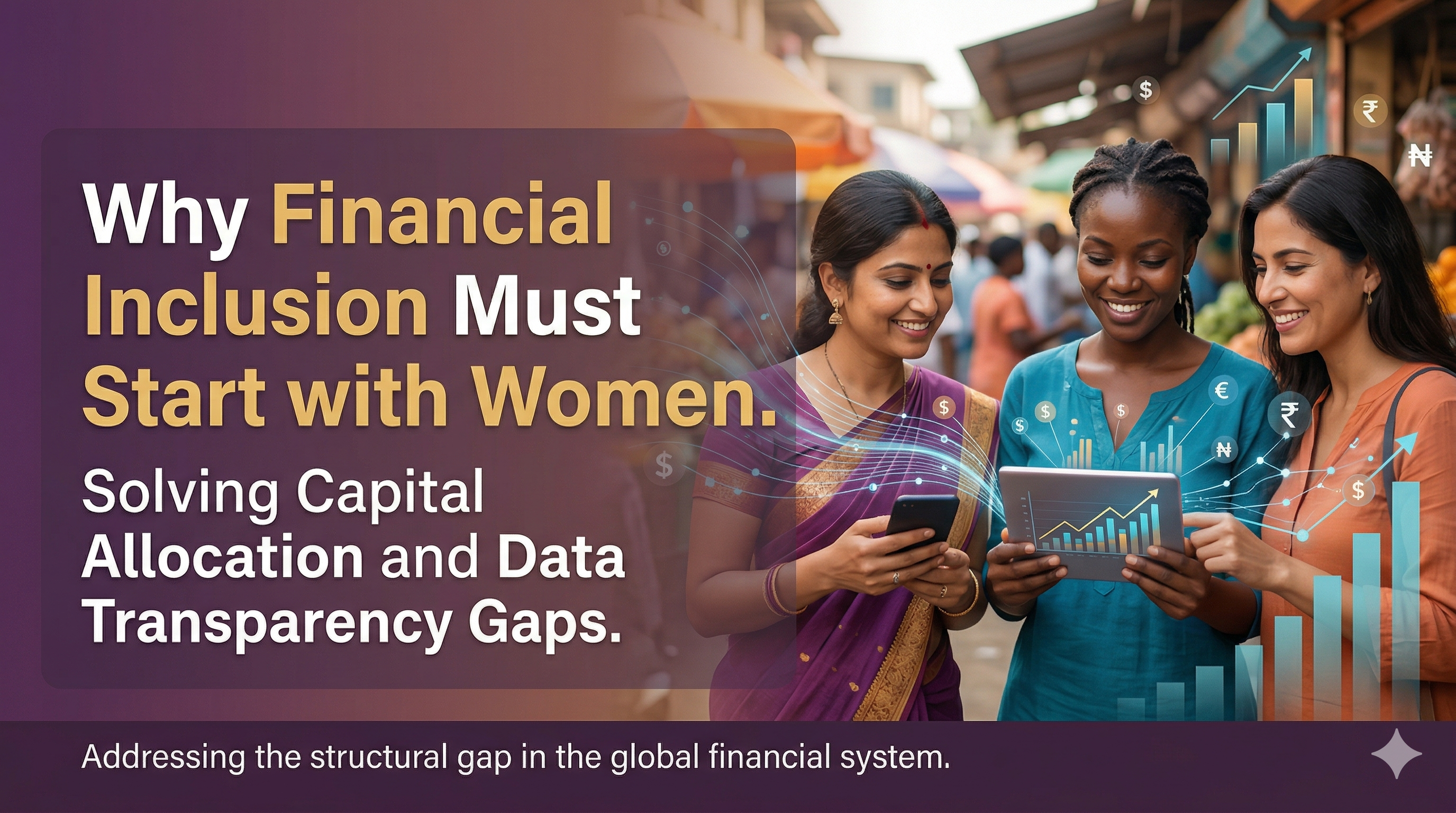
Financial inclusion has been a topic of discussion for decades. Governments, development agencies, banks, and technology platforms have all sought to broaden access to financial services across emerging markets.
Yet, despite these efforts, one truth remains consistently underestimated:
Women are both the most reliable—and the most under-served—participants in emerging market economies.
This is not a marginal or niche issue. It is a significant structural gap in the global financial system—and one of our greatest opportunities for positive change.
The Structural Gap
Across many markets, women still face systemic barriers limiting their participation in formal financial systems.
They frequently experience:
- Less access to formal credit
- Fewer recognized financial identities
- Limited visibility in traditional credit scoring systems
- Reduced access to collateral and ownership structures
This is not a question of willingness, discipline, or capability.
It is a structural design failure.
Traditional financial systems were not built with these realities in mind. They are based on legacy data, rigid documentation, and institutional assumptions that exclude many active participants—particularly women.
The Evidence Is Clear
When access is provided, the results are strikingly consistent.
Across markets and decades of data:
- Women often have higher repayment rates
- Capital is deployed more productively
- Financial discipline tends to be stronger
- Outcomes improve not just for individuals, but for families and communities
- Household stability increases
- Children’s education improves
- Healthcare access rises
- Local economic resilience strengthens
Yet despite all this evidence, women remain underrepresented in formal financial credit systems.
Beyond Microfinance
Microfinance played a critical role in opening doors.
It showed that:
- Underserved populations can be creditworthy
- Alternative lending models can work
- Women, in particular, are strong participants in credit systems
- It has not scaled to match the size of the opportunity
- It has not fully integrated into mainstream financial infrastructure
- It has not leveraged modern data systems or digital identity frameworks
Today, we have the chance to do much more.
A New Approach
At Weritas Foundation, we believe financial inclusion must evolve from isolated initiatives to system-level design.
This means rethinking the foundation of financial access.
Our approach centers on four key principles:
1. Identity comes first: Individuals must be recognized within the system. 2. Credit must be fair and dynamic: Not static or exclusionary. 3. Access must be scalable: Capable of reaching millions, not just thousands. 4. Systems must be inclusive by design: Not retrofitted after the fact.
Here is where technology, data, and new financial architectures matter.
By linking identity, behavior, and access, we can build systems that reflect real economic participation, not just legacy records.
Women as the Foundation Layer
In this new paradigm, women are not a group to be “included later.”
They are the foundation of resilient credit systems.
When systems serve women effectively, they become:
- More disciplined
- More transparent
- More stable
- More impactful
Crucially, the benefits ripple throughout entire communities.
Women are not just beneficiaries of financial inclusion—they are anchors of system resilience.
From Inclusion to Infrastructure
For too long, financial inclusion has been an afterthought—a program, a policy goal, or a corporate social responsibility effort.
That is no longer sufficient.
Inclusion must move to the core of the system.
It must be built into the structure of financial infrastructure itself, so that:
- Access is the default, not the exception
- Participation is enabled by real-world data, not restricted by legacy assumptions
- Credit is a structured capability for the many—not a privilege for the few
The Path Forward
If our objective is to transform economies, not just improve metrics, the starting point is clear:
- Start with identity
- Build fair and dynamic credit systems
- Prioritize women as foundational participants
- Capital becomes more productive
- Communities become more stable
- Economies become more resilient
Conclusion
The future of financial inclusion will not be determined by the number of accounts opened, or transactions recorded.
It will be determined by:
Who is able to participate meaningfully in the economy.
If that is our goal, the way forward is clear:
Financial inclusion must start with women—not as a policy option, but as a structural necessity.